
Psoriasis
Psoriasis is a long-term scaling disease of the skin which affects around 1 in 50 people. IT IS NOT CONTAGIOUS.
It usually appears as red raised, scaly patches, known as plaques. The plaques may appear darker, brown or as purple patches with grey scales. Any part of the skin surface may be involved but the plaques most commonly appear on the elbows, knees and scalp. It can be itchy but is not usually painful. Nail changes, including pitting and ridging, are present in nearly half (40%-50%) of all those who have psoriasis. For those that have psoriasis around 1 in 4 may develop an associated psoriatic arthritis. It causes pain and swelling in the joints and tendons, accompanied by stiffness particularly in the mornings. The most commonly affected sites are the hands, feet, lower back, neck and knees, with movement in these areas becoming severely limited.
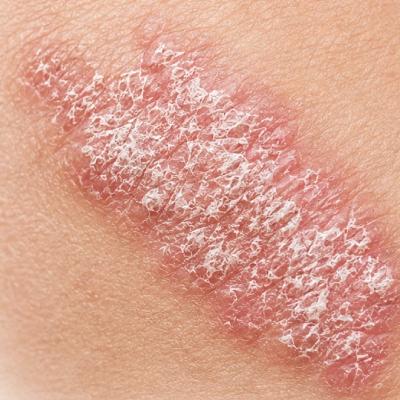
Mild, Moderate and Severe Psoriasis
- Mild psoriasis: With mild psoriasis, people will have a few patches. Typically may not be visually obvious or noticeable but may still need to be treated and generally is not likely to cause problems and can be easily controlled.
- Moderate psoriasis: Moderate psoriasis is when more skin is affected and visually it becomes more obvious. Moderate psoriasis is more widespread but, again, can usually be controlled with self-management under the supervision of a health care professional.
- Severe psoriasis: When psoriasis becomes severe, large areas become covered with psoriasis; the condition becomes difficult to self-manage or no longer responds to treatment.
What Happens?
- Normally a skin cell matures in 21 to 28 days. During this time it travels to the surface of the skin, where it is lost in a constant, invisible shedding of dead cells. In patches of psoriasis the turnover of skin cells is much faster, around four to seven days, and this means that even live cells can reach the surface and accumulate with dead cells.
- It is thought that cells in the immune system (T cells) become overactive, leading to rapid growth of skin cells and the formation of psoriatic plaques.
- The extent of psoriasis and how it affects an individual varies from person to person. Some may only be mildly affected with a tiny patch hidden away which does not bother them, while others may have large, visible areas of skin involved that significantly affect daily life and relationships. The process is the same wherever it occurs on the body.
Causes
- Any infection.
- Stress.
- Over active brain.
- Alcohol and smoking.
- Obesity.
- Genetic (Skip Generation).
Chronic Plaque Psoriasis
- Raised, red, scaly patches mainly occurring on the limbs and the trunk, especially on the elbows, knees, hands, around the navel, over the lower back (sacrum) and on the scalp.
- The nails may be affected so that they become thickened and raised from their nail beds, and the surface of the nail may be marked with small indentations (pits).
- This is the most common type of psoriasis.
Guttate Psoriasis (Raindrop Psoriasis)
- It manifests itself over the body in the form of scaly, droplet-like patches.
- Numerous small, red, scaly patches quickly develop over a wide area of skin, although the palms and the soles are usually not affected.
- It occurs most frequently in children and teenagers, often after a throat infection due to streptococcal bacteria.
Scalp Psoriasis
- Raised, red, thick, scaly plaques on the scalp and around the hairline.
- It is common and approximately 1 out of 2 (50%) of all people with psoriasis have it on their scalp.
Flexural Psoriasis
- Produces red, well-defined areas in skin folds (flexures) such as the armpits, between the buttocks and under the breasts.
- Scaling is minimal or absent.
- This type of psoriasis can be frequently irritated by rubbing and sweating due to its location in the skin folds and other tender areas. Such areas can also be prone to yeast or fungal infections, which might cause confusion in diagnosis.
Napkin Psoriasis
- Develops in the nappy area of an infant to cause a bright red, weeping rash or more typical psoriasis plaques.
- A child who has napkin psoriasis as a baby does not seem to have a higher risk of developing other forms of psoriasis in later life.
Palmar Plantar Pustular Psoriasis
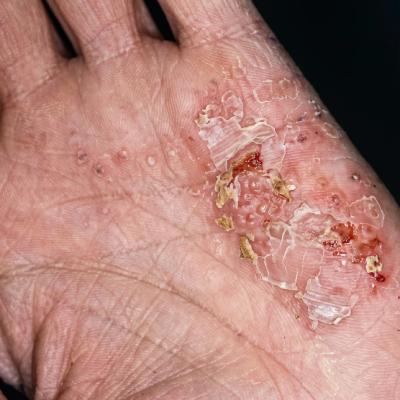
- Small, deep seated pustules form that usually only affect the palms and soles.
- Pustules are caused by the accumulation of white blood cells and are not infected.
Nail Psoriasis
- About half of those with psoriasis (40% to 50%) will have involvement of the nails.
- The fingernails and toenails are affected equally. This may just be one nail, or all of them.
- Discolouration, pitting and separation from the nail bed (onycholysis) are the most common characteristics of activity.
Psoriatic Arthritis (Psoriatic Arthropathy)
- 1 in 4 (around 25%) of people with psoriasis may develop an associated arthritis called psoriatic arthropathy.
- It causes pain and swelling in the joints and connective tissue, accompanied by stiffness particularly in the mornings and when rising from a seat.
- Most commonly affected sites are the hands, feet, lower back, neck and knees, with movement in these areas becoming severely limited.
- Chronic fatigue is a common complaint linked with this condition.
Diet for Psoriasis
- A healthy diet is important for wellbeing and can reduce your risk of many long-term illnesses.
- Aim to eat more green leafy vegetables, nuts, seeds and wholegrain cereals, which also contain important essential fatty acids.
- Cut back on saturated fats and vegetable oils and use more olive oil and rapeseed oil products.
- Eat fresh, homemade foods rather than pre-packaged convenience food.
- Excessive amounts of alcohol can make psoriasis worse.
Classical Homeopathy and Psoriasis
Psoriasis is not only a disease of the skin. It is caused mainly due to stress and emotional imbalances.
Homeopathy treatment believes in the holistic and natural concept.
We follow medicines based on the physical complaints, emotional factors, disposition, and factors worsening the symptom.
Treatment not only aims at relieving the symptoms but treats the main cause for psoriasis. So detailed case taking, family history helps in prescription of medicines.
Homeopathy remedy is highly effective in the treatment of psoriasis without any side effects.
We Shelvi Homeopathy offer Classical Homeopathy Treatment for Psoriasis based on the physical make up, emotional factors, disposition, and factors worsening the symptoms.
Homeopathic medicine helps to relieve from the emotional and mental stress. So the person can relieve from the current indisposition.
Diet and lifestyle management helps in improving the basic life of the person.
Homeopathic medicine improves the immune system, there by increasing the possibility to fight against the psoriasis.
Other Skin Treatments
Explore related homeopathic services under Skin.